Oct 19
/
Gita Faust
What If Your Tax Return Is Right… But Your Books Tell a Different Story?
Three Reports. Three Different Numbers. Which One Would the IRS Believe?
Your accountant filed your tax return. Your property manager sent the reports. Your bookkeeper reconciled QuickBooks. Everyone did their job, and everything should be fine, right?
Well, here's a question nobody seems to be asking.
Do all three sets of numbers actually agree?
And if they don't, who is responsible for explaining the difference?
That's where things get interesting.
I've worked with real estate investors for years, and one thing still surprises me. Property owners can tell me exactly what they paid for a property, how much rent they're collecting, and what their monthly mortgage payment is. But ask them how those numbers ended up on their tax return, and suddenly the conversation gets quiet.
Here's the interesting part. Sometimes the bookkeeping is wrong. Sometimes the tax return is correct, but the accounting records don't seem to support it. And sometimes both sets of numbers are perfectly reasonable, but they're telling different parts of the story.
That doesn't automatically mean there's a tax problem. But wouldn't you rather understand the difference before someone else starts asking questions?
When Three Reports Tell Three Different Stories
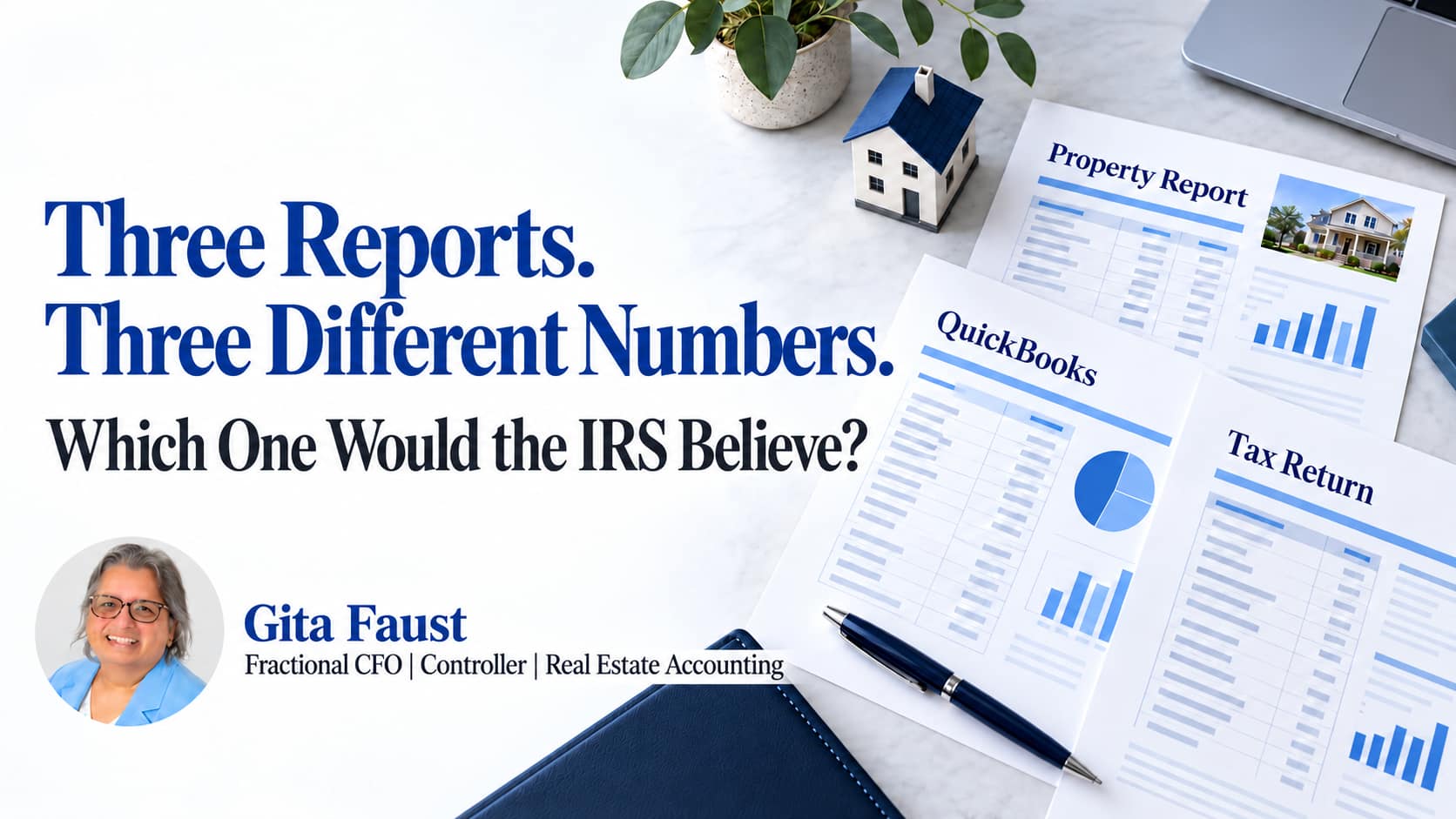
Imagine you own several rental properties. Your property manager sends you a monthly statement, your bookkeeper maintains your QuickBooks file, and your CPA prepares your tax return. Three professionals, each doing their job, and you naturally assume they're all working with the same financial information.
But are they?
Let's say your property management report shows $150,000 in rental collections, QuickBooks shows $142,000, and your tax return reports $138,000. Which number is correct?
Before you panic, there could be perfectly reasonable explanations. Perhaps the property management report includes refundable security deposits, the reports cover different periods, or some transactions were classified differently. Depending on your accounting and tax reporting methods, the amounts may legitimately differ.
The real question isn't necessarily which report is wrong. It's about whether someone can explain why the numbers differ and provide the supporting records.
And that brings me to something I see far too often.
Everyone Is Doing Their Job. But Who's Connecting the Dots?
Your property manager focuses on tenants, maintenance, and rent collection. Your bookkeeper is recording transactions and reconciling accounts. Your CPA is preparing your tax return based on the information available.
Each person has a responsibility, but who's looking at the entire financial picture?
I've seen situations where a mortgage payment cleared the bank every month, yet the loan balance in QuickBooks hadn't been properly updated. I've seen property owners pay thousands of dollars for repairs out of their personal accounts, only to discover those expenses never made it into the property's financial records. And I've seen security deposits recorded as rental income instead of liabilities.
None of these situations necessarily involves someone intentionally doing anything wrong. Often, the business has grown, responsibilities have been divided among different people, and nobody has stopped to make sure everything connects.
The property manager has one number, QuickBooks has another, and the tax return has a third. Meanwhile, the owner assumes somebody has checked.
That's where trouble can begin, because the answer isn't always in a single report. Sometimes you have to follow the money through several systems before the full picture makes sense.
And somebody needs to be responsible for connecting those dots.
Your Bank Balance Isn't Your Report Card
Here's a conversation I've had with more investors than I can count.
I'll ask, "How's the property doing?" and the response is usually something like, "Great! There's plenty of money in the bank."
Wonderful! I love hearing that. But having money in the bank doesn't necessarily mean the property is profitable.
That balance might include tenant security deposits, funds set aside for upcoming repairs, or cash soon needed for property taxes, insurance, and mortgage payments. It also doesn't tell you how much of your mortgage payment goes toward principal rather than interest, whether you're keeping up with expenses, or whether the property is performing as well as you think.
And it certainly doesn't tell you whether the numbers on your tax return can be traced back to reliable financial records.
That's why I encourage property owners to look beyond their checking accounts. Review the Profit and Loss statement, look at the Balance Sheet, and compare the accounting records with the property management reports. More importantly, ask questions when something doesn't make sense.
You don't have to know every accounting rule, but you should understand what your numbers are telling you.
There's a big difference between saying, "I think my property is doing well," and being able to explain why.
What If Someone Asked for Your Records Tomorrow?
Now, I'm not suggesting you should lose sleep worrying about an IRS audit. But imagine receiving a request for records supporting the information on your rental property tax return.
Would you know where to start?
Could you find the invoices and supporting documents for a major renovation? Could you explain why the mortgage balance in QuickBooks doesn't match the lender's statement? Would your rental income records support the amount reported on your tax return? And if you own several LLCs, could you explain the money moving between them?
These are reasonable questions that can come up during an audit, a loan application, a property sale, or even a routine conversation with your CPA.
I've met plenty of owners who tell me, "Oh, I have all that information somewhere."
And maybe they do. Somewhere in an email, a filing cabinet, a property management system, or a spreadsheet that hasn't been updated in six months.
But having the information somewhere and being able to produce accurate, organized records are two very different things.
The problem isn't always missing information. Sometimes it's that nobody has connected it, reconciled it, or confirmed that it agrees with what's being reported.
And the longer those differences go unnoticed, the more time and money it can take to straighten them out.
Good Books Should Help You Make Decisions, Not Just File Taxes
Here's what I really want property owners to understand. Good bookkeeping isn't something you do once a year to make your CPA happy.
Your financial records should help you run your real estate business.
Think about it. How can you decide whether to buy another property if you don't know what your existing properties are actually earning? How can you budget for renovations if you're not tracking the true cost of maintaining each property? And how can you evaluate whether your property manager is meeting expectations if your reports don't give you a reliable picture?
When your records are accurate and organized, tax preparation becomes easier, financial questions are easier to answer, and you can make decisions with more confidence.
Instead of wondering where the money went, you can see what happened, understand why, and decide what to do next.
That's when accounting becomes more than recording transactions. It becomes a tool for managing your investments.
Before Your Next Tax Return, Ask Yourself One Question
If your CPA called tomorrow and asked you to explain a number on your rental property tax return, could you?
About the Author
Not because you memorized the tax code or spent every weekend studying QuickBooks, but because you have reliable reports, reconciled accounts, and supporting documentation.
If your answer is "I'm not sure," that's okay. At least now you know where to start looking.
And you don't have to wait until tax season to find out.
I've created a free How Tax-Ready Are Your Real Estate Books? quiz to help you take a closer look at your records, identify potential gaps, and think about what might need attention before your next tax return.
[Take the Free Tax-Readiness Quiz →]
I also recently wrote an article for the American Apartment Owners Association (AAOA) titled IRS Audit: Are You Next? In that article, I explore some situations that can raise questions about rental property tax reporting, from documentation and ownership structures to financial records that don't reconcile.
If you're curious about what might put your rental property records under closer examination, it's worth a read.
[Read My Original AAOA Article →]
At the end of the day, my goal isn't to make accounting more complicated. It's to help you understand what your numbers are actually saying.
Because there's nothing quite like going from "What the heck is this?" to "Oh, that's where the money went."
And wouldn't it be nice to figure that out before tax season?
About the Author
Gita Faust is a Fractional CFO, Controller, and Advanced Certified QuickBooks ProAdvisor with more than 25 years of experience helping real estate investors understand their financial numbers, clean up their accounting records, and make better business decisions. She is the founder of RealEstateAccounting.com.
This article is for educational purposes only and does not constitute tax or legal advice. Tax treatment depends on individual circumstances. Consult a qualified tax professional regarding your specific situation.

© 2026 Gita Faust with RealEstateAccounting.com. All rights reserved.
Intuit and QuickBooks Are Registered Trademarks of Intuit Inc.