
2026 Meals and Entertainment Tax Rules: What Business Owners Need to Know
You take a client to lunch. You discuss business, pick up the check, and pay with your company credit card.
Business expense, right?
Well, yes. But that doesn't mean the IRS will let you deduct the entire amount.
And starting in 2026, some meals that businesses have deducted for years are no longer deductible under the usual rules.
I've seen business owners put everything from coffee and client lunches to sporting events and employee celebrations into one QuickBooks account called Meals & Entertainment.
Then tax season arrives, and someone has to figure out what actually qualifies.
Sound familiar?
Here's what you need to know.
The IRS generally separates meals and entertainment into three categories: 100% deductible, 50% deductible, and nondeductible.
Generally 50% deductible:
- Meals with clients, customers, and prospective clients when there is a legitimate business purpose.
- Meals during qualifying overnight business travel.
- Meals at business conferences and meetings, subject to the applicable rules.
- Food and beverages purchased separately from entertainment, when properly documented and otherwise eligible.
Generally 100% deductible:
- Employee holiday parties, company picnics, and similar recreational events primarily benefiting employees other than highly compensated employees.
- Certain food and beverage expenses made available to the general public.
- Qualifying food expenses treated as taxable compensation to employees.
Generally nondeductible:
- Sporting event and concert tickets purchased to entertain clients.
- Personal meals.
- Many employer-provided meals and snacks that previously qualified for a 50% deduction.
The circumstances matter. Calling something a business expense in QuickBooks does not determine its tax treatment.
Here's something worth checking before you close your books.
Beginning January 1, 2026, the One Big Beautiful Bill Act's changes to Internal Revenue Code Section 274 generally eliminate deductions for certain employer-provided meals.
For example, meals provided for the convenience of the employer and certain on-premises food and beverages that previously qualified for a 50% deduction are generally no longer deductible.
That may include coffee, snacks, and meals furnished to employees under qualifying employer-convenience arrangements.
There are exceptions, so the purpose and circumstances still matter.
And here's the interesting part.
A qualifying employee holiday party may still be 100% deductible, while ordinary breakroom snacks may not be deductible at all.
Same business. Different rules.
Suppose you purchase two baseball tickets for $300 and spend another $80 on food.
You discuss business during the game.
Can you deduct the entire $380?
Generally, no.
The $300 tickets are entertainment expenses and nondeductible.
But the $80 spent on separately purchased food and beverages may qualify for a 50% deduction, assuming the business meal requirements are satisfied.
That could mean a $40 meal deduction and no deduction for the tickets.
One outing. Two different tax treatments.
This is why recording the entire $380 under Business Meals can create problems.
I recommend keeping your Chart of Accounts simple but separating expenses with different tax treatments.
Consider these accounts:
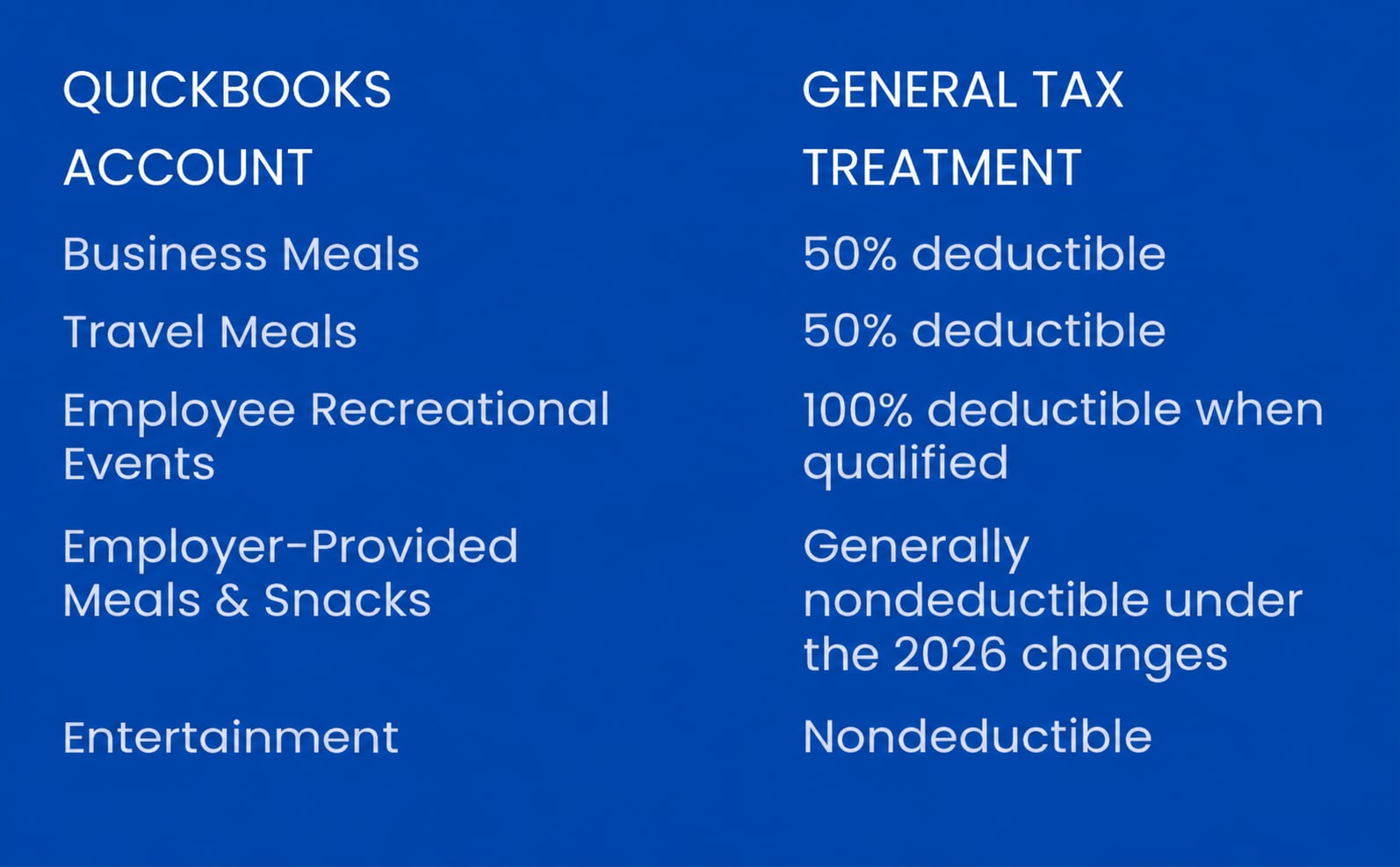
Personal meals paid through the business should generally be recorded as owner distributions or another appropriate owner-related account, depending on the business structure.
Promotional events and advertising should be tracked separately and evaluated under their applicable rules.
You do not necessarily need dozens of accounts. You need enough detail to distinguish the tax treatments.
Here's one mistake I want business owners to avoid.
If a client lunch costs $100 and qualifies for a 50% deduction, record the full $100 in QuickBooks.
Not $50.
Your Profit & Loss statement should reflect what your business actually spent.
The 50% deduction limitation is addressed when preparing the tax return.
Otherwise, your financial statements may understate your expenses.
And when you're trying to understand where your money went, that's the last thing you need.
For business meals, document the date, amount, location, attendees, and business purpose.
A note such as "Lunch with John" doesn't explain much.
Try this instead:
"Lunch with John Smith to discuss financing options for the next rental property acquisition."
Keep the receipt and supporting information.
The IRS expects adequate records, and your CPA shouldn't have to guess why an expense occurred.
Here's what I want you to remember.
Your books serve two different purposes.
They help you understand how much money your business actually spent.
And they provide the information needed to calculate your allowable tax deductions.
Those numbers aren't always the same.
When everything gets dumped into one Meals & Entertainment account, you lose the detail needed for both.
Before your next monthly close, take five minutes and look at that account.
What's actually in there?
Client lunches? Employee meals? Entertainment tickets? Personal purchases?
You might be surprised.
Want to know what else your financial reports may be hiding?
About the Author
Gita Faust is a Fractional CFO, Controller, and Advanced Certified QuickBooks ProAdvisor with more than 25 years of experience helping real estate investors understand their financial numbers, clean up their accounting records, and make better business decisions. She is the founder of RealEstateAccounting.com.
This article is for educational purposes only and does not constitute tax or legal advice. Tax treatment depends on individual circumstances. Consult a qualified tax professional regarding your specific situation.